Blog

The Vagus Nerve, Yoga and the Heart

With all the focus on aerobic exercise, you could be forgiven for thinking that what your heart wants is for you to constantly running, swimming or cycling. But a number of Vagus nerve anatomy, illustrationmedical studies are showing that practicing yoga can significantly contributes to cardiovascular health. These days, doctors and other health practitioners are increasingly recognizing the benefits of yoga for the healthy functioning of the heart. More research, particularly in the past five years, is revealing how regular yoga practice can help to manage the levels of cortisol and adrenaline – the fight or flight/stress hormones – that stimulate the sympathetic nervous system and put pressure on the heart by narrowing the arteries and raising blood pressure.
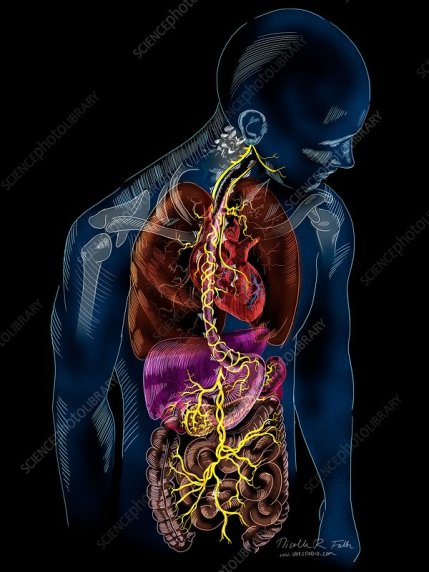
This calming effect on the body and mind is due in large part to the activity of the Vagus Nerve, that has been dubbed the “air traffic controller” of our nervous system. The Vagus is our largest cranial nerve, connecting the brain to the rest of the body via the facial muscles, heart, lungs, digestive tract, kidneys and reproductive organs. The Vagus Nerve plays a key role in the function of the parasympathetic nervous system (our ‘all-safe’ response) and helps to regulate many bodily functions including breathing, digestion as well as how we receive and interpret information from our environment, in particular our social environment.

What is fascinating cardiologists is the connection between the Vagus Nerve and the heart. They have discovered that the Vagus Nerve regulates heart rate through electrical signals and the release of the neurotransmitter acetylcholine. It is this neurotransmitter that tells our lungs to breathe. And here lies a key. If our body is getting flooded with stress signals what can we do? It turns out that we can indirectly stimulate the Vagus Nerve (and thus develop a more finely tuned response to danger and safety) by working with the areas and functions that it controls; throat, lungs, heart and abdominal organs, but especially by working with our breath.

Pranayama, the kind of slow, rhythmic abdominal breathing that we learn to do in yoga has been shown to stimulate the Vagus Nerve and improve what is called ‘vagal tone’—that is, the body’s ability to accurately interpret signals of danger and safety and to better cope with stress. This practice, embedded for centuries within ancient wisdom traditions, is fast coming to be seen an advanced biohack technique and a promising part of the future of medicine.

For information email: lavieenyoga@gmail.com
https://www.facebook.com/groups/lavieenyoga/

Respect yourself, explore yourself.
Rebecca
The Gentle Art of Resilience

resilienceSeveral years ago, when I was working in radio production for a program in Los Angeles, I interviewed Dr. Andrew Weil, a renowned holistic health doctor. One of the questions I asked him was, ‘What is your definition of health’ to which he replied instantly, ‘Health is resilience’. What he meant by this, as he went on to explain, was that health is not something that can actually be measured in terms of a stack of test results, since the body is constantly in flux. Our physical processes are changing all the time in relation to many different factors. Health, therefore, is also not a static measurement. Ill-health occurs when things go out of balance to a point where one or more bodily system begins to break down. Health is not when the body is in perfect balance. There is no such thing. It is rather the ability of the body to cope with the stresses that are constantly being placed on those systems. This is resilience.
In other words, resilience is the ability to cope with changes in the body. But there is another extremely important kind of resilience — the ability to cope with changes in our lives. A change might be an enormous upheaval such as the death of a loved one or the end of a relationship, or simply the ability to deal with day to day disappointments or an annoying neighbour. As Heraclitus was famous for pointing out, ‘nothing endures but change’. Change is really the only thing we can rely on, so learning to cope with changes in our lives is nothing short of a super-power.

If our life resilience declines, the good news is that we can build it up again. We can begin by developing resilience to smaller difficulties, and through familiarity, we can learn to apply the same skills to the major challenges that we are all inevitably going to face one day, and to the ones we might face as soon as a few minutes from now. It’s a package that includes insight, kindness (to oneself and others), adaptability, creativity, and humour. Resilience creates a rubbery layer between us and change that provides a softer landing for life’s blows.

Yoga is a wonderful way to develop resilience that benefits both our bodies and minds. We learn to stay with a challenging pose in a compassionate space, exploring it for what it can teach us. We build strength and endurance through a gentle testing of our limits and discover new ways to go beyond them. We learn to giggle rather than tut when we topple over, as we inevitably will do at times. And we learn to breathe through the changes, rest when we’ve had enough, and conserve our energy for the next move.

Respect yourself, explore yourself

Rebecca

lavieenyoga@gmail.com
https://www.facebook.com/groups/lavieenyoga/


What kind of Yoga is right for you?

I am often asked what kind of yoga I teach. My answer is Hatha Yoga with an
Iyengar influence. But what does that mean? The word ‘yoga’ is often translated
simply as ‘union’, referring to the union of body and mind. Hatha in its simplest
definition means ‘force’ since it is involved in breaking habits of the body through a
certain level of exertion but the word also refers to the power behind the force itself.
Hatha is the general system of yoga poses (asanas) and breathing techniques
(pranayama) from which all modern yoga schools stem, and is made up of word
roots reflecting the union of opposites.

Ha – signifies the sun, the right side of the body, the masculine principle and energy.
Tha – signifies the moon, the left side of the body, the feminine principle and
relaxation.

Hatha yoga is included within the 8 branches of Ashtanga Yoga, an ancient system
of practices that was compiled and elucidated by the Indian sage, Patanjali, in the
Yoga Sutras in the early fifth century CE. All forms of yoga today originated as part
of this comprehensive system that includes ethical discipline, somatic purification
practices, textual study and meditation.

Over the centuries, the postural and breathing techniques of Hatha Yoga began to
gain popularity among the laity outside of the ashrams, and eventually it emerged as
its own discipline. Even today, in India, when someone says they are doing yoga this
is generally what they mean. It wasn’t until the 20th century, that yoga began to sub-
divide into the different schools that we see today.

Swami Sivananda (1887-1963) and Krishnamacharya (1888-1989) both contributed enormously to reviving interest in yoga in India that had waned after a peak in the middle ages. Swami Satyananda (1923-2009) founded the Bihar School of Yoga, the lineage in which my own teacher, Sri Surinder Singh, was trained. Around the same time, K. Pattabhi Jois developed a modern version of classical yoga, called Ashtanga Vinyasa Yoga.

YehudiMenuhin
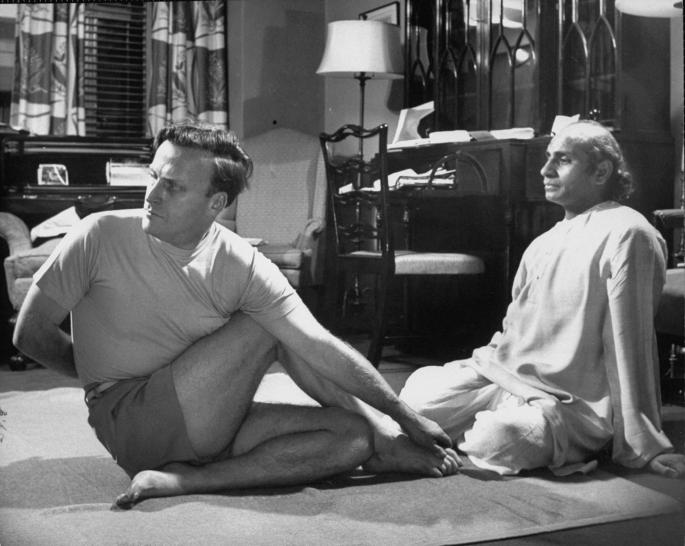
The violinist, Yehudi Menuhin doing yoga with B.K.S. Iyengar. Menuhin suffered from severe muscular pain which he claimed was cured through yoga. Photo: 1952

But it was B.K.S. Iyengar who perhaps had the greatest influence in bringing yoga to
the West. He founded his own yoga school in the 1950s, emphasizing precision
alignment and the use of props such as blocks, blankets and belts. One of his most
famous students was Yehudi Menuhin who was so convinced that yoga improved his
musical abilities that he liked to refer to B.K.S. Iyengar as “my favourite violin
teacher”.

Today, there are numerous other yoga schools, and some are controversial, so it’s
good to do some research beforehand. There is Bikram Yoga (sometimes called ‘hot
yoga’ because it’s performed in a room at temperatures up to 40 Celsius), Anusara
School of Hatha Yoga, Integral Yoga, even Kundalini Yoga that claims to awaken the
dormant energies at the base of the spine. And with the West’s love of endless
categorizations, more yoga schools seem to be popping up all the time. Lately, I have been incorporating more Somatic Yoga into my classes (see DSM’s September
issue) with gentle flow through movements that work to reprogram muscle memory.

What type of yoga you end up doing will be based on a number of factors, including
accessibility and your own personal motivations. The best way is always to get a
recommendation from someone you know and trust and don’t be afraid to try out
difference classes. There are a number of yoga teachers in the Deux-Sèvres so you
might find one down the road! And it’s worth remembering that not all types of yoga
will suit everyone. Find the style that works for your own body and mind. If you feel
happy when you leave the class, that’s the best indicator!

For information email: lavieenyoga@gmail.com
https://www.facebook.com/groups/lavieenyoga/

Respect yourself, explore yourself

Rebecca

Tree Pose: Balance in all things

Balance is something we’re always working towards, whether it’s balancing work with play, exercise with relaxation, the elements of our diet, or the dynamics in our relationships. Too much of one thing might tip us over, and not enough of another can make us feel deprived. The benefits of Tree Pose include helping not only our physical balance but our mental balance as well, since it requires a certain amount of concentration. You’ll find that if you start thinking about your to-do list while in this pose, or an argument you just had with someone, you’re more likely to wobble! It is amazing to observe the impact that the activity of the mind has on the body. This pose is also fantastic for strengthening the muscles of the feet and ankles, the knees and legs, and in improving overall posture.

First, stand with your feet and ankles together, feet straight. Ground your soles and toes firmly into the floor. Keep the arms loose at the sides, relax the shoulders, and inhale as you lift the chest and upper back. Shift your weight onto your left foot and, with the help of your right hand, bring the right sole flat against the left leg, either above or below the knee. You can begin doing this pose by standing just enough away from a wall so that you can touch it with the end of your finger. A light touch is all you need to control your balance. Practice removing your finger from the wall for a few seconds, increasing the time with each practice.

Tree Pose

If you’re doing the pose away from the wall, you can either put your hands with palms together overhead, or simply place your palms together at the chest. Stand tall, lengthening through the tailbone, lift the head, and connect your gaze to a point directly in front of you. Imagining yourself as a tree with roots coming out of your soles can actually help you to keep stable. Breathe nice and slow. When you’ve had enough, exhale and repeat on the other side.


For information on classes email: lavieenyoga@gmail.com

https://www.facebook.com/groups/lavieenyoga/


Respect yourself, explore yourself.

Rebecca

Warrior Pose – Facing the challenge

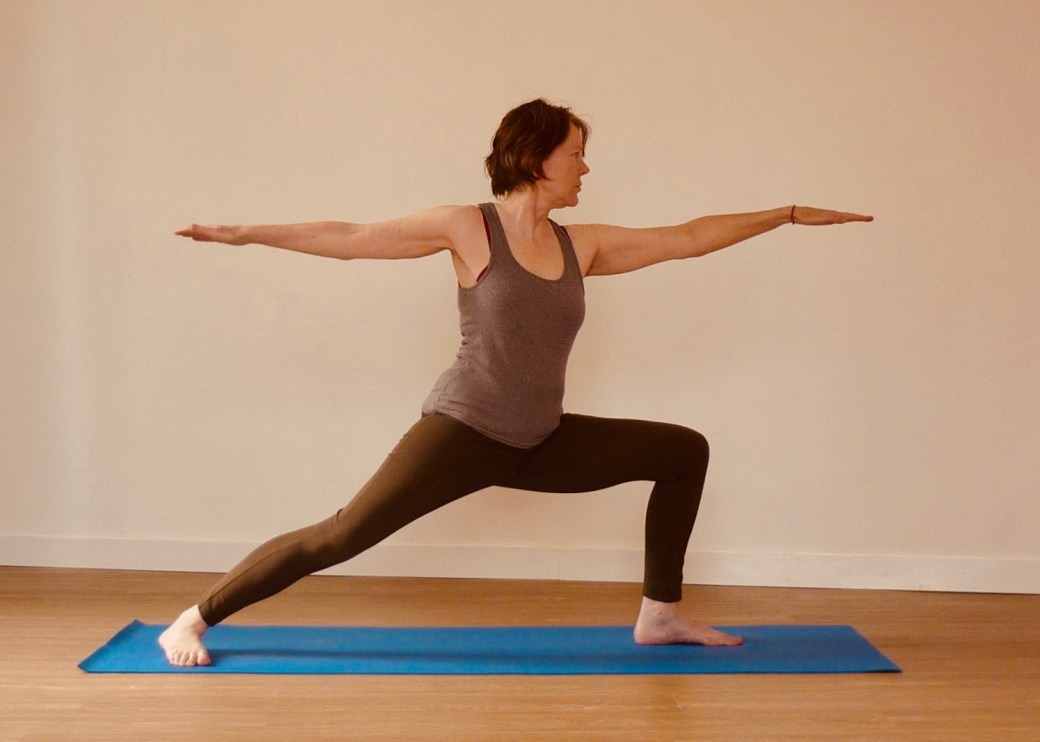
In Hindu mythology, the great warrior Virabhadra, has a thousand heads, a thousand legs, a thousand eyes, and a thousand arms, each wielding a weapon. Needless to say, he is quite the adversary. On the one side, he represents the ego that rises against us again and again to cause us to suffer—to get angry, disappointed, and sad. On the other, he represents external challenges that come to face us in our lives. In truth, the two operate in unison, with external events triggering certain responses in our ego mind. The warrior poses tune our bodies to a position of strength, alertness, stability, stamina, and confidence with which to face our challenges. At the body level, Warrior II strengthens the legs and stretches the ankles. It opens up the groin, chest, and shoulders and encourages a strong alignment of the core and back muscles. It takes a lot of energy to maintain the warrior poses, so go easy on yourself, especially at first. Strength and stamina are built gradually, over time.

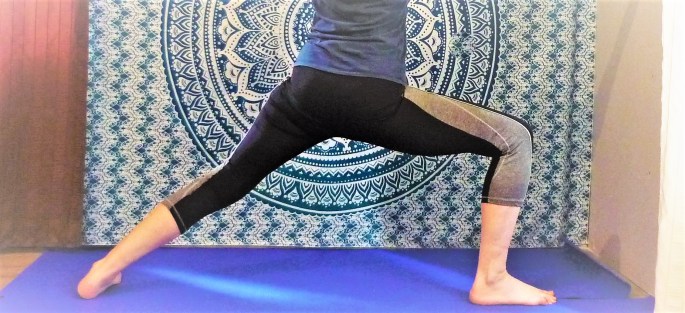
Warrior IIStand with your feet about 3 feet apart with heels in alignment. Turn your right foot to 90 degrees and your left foot to about 45 degrees. You might want to widen your stance a little for more stability. Raise both arms, and gaze softly over the top of your right hand. Relax the shoulders. Sink your torso down (not forward), bending the right leg as deep as you can comfortably go, ensuring that your right knee does not fall inwards or outwards. Ideally, you should be able to just see your right toe when you look down, with your right shin perpendicular to the floor. Ground your back foot, particularly the big toe and the outer heel into the floor, making the back leg strong and stable. Stay here for 4 or 5 breaths. Repeat on the other side.


For information on classes email: lavieenyoga@gmail.com

https://www.facebook.com/groups/lavieenyoga/


Respect yourself, explore yourself.

Rebecca


Have the hips of a mermaid

Our hips do so much for us but they are often an area of tension. A large hip muscle called the psoas, that extends from the lumbar region to the femur bone, is part of our body’s “fight or flight” response, contracting and tightening when we feel stress. Cyclists often have tight hip flexors because the hips never get into full extension on the bike. Yoga poses to open the hips (‘hip openers’ as they are called) can therefore offer relief and improved performance. Loosening tight hips increases our range of motion, and can help to alleviate back pain since when our hips are tight it is the spine that takes up the burden. These poses sometimes feel quite intense and challenging but they can yield powerful results.

 I call this pose the Melusine after the river goddess known in Western France because from above it looks a bit like a mermaid holding her tail. If you have a yoga mat great, otherwise you can just do this on a carpet. If you sit a lot it is great to break up your seated sessions with this pose once or twice a day.

Lie down on your back with your arms to the side and your knees bent. Slip your right foot under your left thigh and take hold of the top of your right foot with your left hand. Bring the left foot across and over the right thigh and place it on the outside of the right knee with the foot facing forward. Bring your right arm up overhead to open up the chest a little, and turn your head to the left. If you have trouble reaching the right foot, especially if you experience any pain in the knee knee, then just bring the foot as far as is comfortable, keeping the extended right thigh as straight as possible. Relax the lower back muscles and breathe into the position. Hold for 20-30 seconds paying attention to how you feel. Repeat on the other side.

Melusine Lenny
When Lenny my cat decides he wants to be part of the pose 🙂

Respect yourself, explore yourself.

Rebecca

For information on classes email: lavieenyoga@gmail.com

https://www.facebook.com/groups/lavieenyoga/

Plantar Fasciitis: How I healed the heel in under 6 weeks

Last month I decided to do a bit of running. Well, the mornings here in Western France were beautiful, and I found a lovely two kilometre route that took me across medieval bridges, over misty rivers, and down green-lined country lanes. I do a lot of yoga (I am a yoga teacher, after all, but felt that I wasn’t getting enough aerobic exercise. I loved swimming but my logic was, running is free. It turned out that it cost me about $200 and about a month of my life that I don’t wish to repeat.

It was the morning after my third run that I discovered a dull pain in my heel and around my instep that gradually got worse throughout the week. I went online and discovered that I had a bad case of something called Plantar Fasciitis. It refers to a tear in the ligament (fascia) that runs from the heel down the length of the foot. I had never heard of it before, but I quickly began to learn all I could because in a few days I could barely walk. It turns out I had not been very smart. I knew I had one leg shorter than the other from a motorcycle accident in my teens, so this combined with including hills in the routine, running partly on asphalt, not warming up, all created a perfect storm to render me largely out of action. Not everyone gets plantar fasciitis from running. A friend of mine got it from being on her feet all day in bad shoes at a charity function. It took her eight months to recover.

The pain was bad first thing in the morning and built up during the day with use, so that it became difficult to sleep. It was the kind of pain that saps your energy and adds a layer of grumpiness to all your interactions, and I found myself unusually short-tempered.  Pain can do that to a person. I thought it would just clear up with a bit of rest, but I was wrong.

I kept reading about how long this condition can take to resolve. One site I looked at said that ‘most cases resolve between 8 months and a year’. A year?! No, no, no. That was not going to be me.

Over the next four weeks, I threw myself into a therapeutic routine that resulted in a dramatic improvement by the end of the third week, and almost total recovery by the end of week four. And all without a single visit to the doctor. It generally takes a minimum of six weeks and often several months to treat this painful and debilitating condition. I need to preface this by saying that I work from home, don’t have children, and was in a financial position to get a few things on Amazon to help in my recovery. Not everyone is so fortunate. But in the hope that some people might benefit from my experience, here is how I did it.

Four times a day for the first two weeks:

  • Ice the heel and sole of the foot with a cup filled with frozen water, for 10 mins each time. I also sometimes used the classic pack of frozen peas. Once into the third week, you may be able to reduce this to twice a day.
  • After icing the foot, use the ‘graston’ technique, which is basically working the fascia of the foot with a soft-edged implement. You don’t need to visit a doctor for this, you can do it yourself and don’t let anyone tell you otherwise. I used the back of an ordinary knife from my cutlery drawer. Other people have even used an ordinary metal wrench, so be creative, as long as it has no sharp edges. However, if your hips are not too flexible and it is difficult for you to get into the positions to perform graston on yourself get a friend or family member to do it for you while you lie on your stomach. Graston helps to work and stretch the fascia and increase blood flow to the foot. Focus on the bottom of the foot and the back of the calf. This technique also helps to break down old scar tissue so was very helpful in my case, since the scar tissue around the ankle from my old injury was not helping the blood circulation any. See a demonstration of self-applied graston technique. This kid really has it down and helps to show how to reach the hard to get to areas. Ignore his Jurassic Park tee-shirt and obvious lack of earth years. He’s an old soul and has got the goods. Doing this stuff is boring, but you need to do it for at least 5 minutes each time to get the benefits.By the third week, I was only doing icing and graston twice daily, and by the beginning of the fourth week, I had more or less stopped both entirely since the healing was in such full swing by that point that for the first time in a month I looked forward to going for a walk!

Every day:

  • Take glucosamine and chondroitin tablets. I highly recommend ‘Move Free’ by Schiff that costs around $40 for 140 tablets. I’ve also heard that Capra’s CapraFlex works well. Once I started taking these (2 a day with a little food) the pain eased off considerably. Glucosamine is an amino acid that works to repair connective tissue, like the plantar fascia. It also can reduce or even eliminate the need for anti-inflammatory medication such as Ibuprofen since it helps to reduce pain. Interestingly, people who take glucosamine supplements don’t appear to get plantar fasciitis. Here’s a list of some other vitamins/supplements you might want to consider to speed up your healing.

Every night:

  • A painkiller. Before the glucosamine/chondroitin arrived (I ordered it online) I did use a pain cream called Voltarol Pain-eze that worked pretty well. The use of painkillers will obviously depend on one’s own pain thresholds and sensitivities. Doctors will most likely prescribe you industrial strength Ibuprofen for this condition, but you shouldn’t really need it, especially once you begin taking the glucosamine, and your liver certainly doesn’t!
  • Use a night splintAt night, the foot tends to point, and so it shortens the fascia, so the purpose of the heel splint is to stretch the plantar fascia ligament while you sleep.I took a man’s tie and wrapped it around my foot so that the heel was a little scrunched and it was difficult to point the toes. It looked kind of cool, like a warm up for Kinbaku. If you’re not good at knots, you can also use a special tape for this or even better, order a proper heel splint.  I stopped using my homemade heel splint after the end of the second week, since the recovery was well underway. Studies suggest that heel splints do promote faster resolution of this condition, but you can judge for yourself whether you think it’s helping or not.

Essential:

Get some orthotic insoles. You will want to kiss yourself when they arrive for being so in touch with your self-care! You can find them easily online or at your local pharmacy. The best kind are quite firm and conforming, giving a little heel cushioning, and you can slip them into your shoes and even wear them with heeled sandals. Take your time to look at the customer reviews before you order. Not all insoles are created equal.

Optional:

  • Dry cupping. Since I had a lot of old scar tissue that was getting in the way of healing, I ordered a dry cupping set. Cupping has been used in China and in many Muslim countries (where it is called ‘hijama’ and apparently was recommended by the prophet Muhammad) I had a lot of fun using it around my ankle. It is not easy to cup in this part of the body though, and almost impossible to get enough grip on the heel itself, so I wouldn’t bother unless you just really like messing around with ancient healing techniques like me.
cupping
My first cupping set

Important tips:

  • Don’t go barefoot or wear completely flat shoes. If you’re a woman (or a man with flair) you can get a lot of relief from wearing some block heeled shoes about two inches high. Clogs might be the best option (not stilettos!) even though they may not look very sexy. Heels elevate the heel and so you can walk with less pain, but avoid shoes with any kind of backstrap. I wore a heeled shoe with a very soft leather back strap one day, and one five minute walk to the shops was enough for me to remove it. I would not have been able to function, especially in the first two weeks without wearing some height under me. Just be careful, especially if, like me, you’re not used to heels. If you got this condition through running, chances are you invested in some running socks along the line, that have supported heel stitching. Wear them, they will feel friendly.
  • Don’t exercise. Zip. Nada. I mean it. I went swimming in my first week and it set me back in my recovery. You can do upper body work but not with weights. You don’t want to put any unnecessary strain on your foot. A lot of websites will tell you to do the runner’s stretch against the wall to stretch out your calf muscle. I did this the first couple of days and it made my condition worse since it also stretched the heel! Ouch! Graston is a much safer and more effective way to work the calf muscles when plantar fasciitis is your problem.You can do some simple things like core building exercises (slowly raising and lowering your leg) and remove any stiffness in the ankle and increase blood flow by doing gentle ankle rotations a few times a day, in both directions. Do both ankles, not just the injured foot. You are going to be favouring your good foot when you walk. This is natural, but try to do this as little as possible so you don’t cause an injury to your hip or knee by suddenly putting a lot of extra weight on it. And if this means walking with a stick for a couple of weeks, so be it. Get a cool cane with a dragon head eating the sun or something. Imagine it’s a magic staff. Think Sherlock Holmes or Gandalf!
  • Walk as little as possible in the first ten days. Of course, this is hard to avoid. But just really think about each walking trip you do and whether it’s absolutely necessary. Do you have to go to the shops. Can it wait? In the second week begin to walk a little, perhaps to the end of the road and back. In the third week, you can walk ten to fifteen minutes at one time, building it up gradually. You do want to begin to re-engage the injured foot, but you want to be careful not to RE-injure it. Listen to your body.
  • Drink lots of water. Water helps to purify the body of toxins, so drink lots of the stuff. Purified water only, and with nothing added to it even though you want to dress it up a bit. Water makes almost everything better. Just do it.
  • Avoid inflammatory foods. If you don’t know what this means, find out. It will do you well in the long-run.
  • Let people help you. If you’re single you might be like me and used to doing things on your own, so this might be a hard one. But you’ll probably be pleasantly surprised how ready people are to give you a helping hand, whether it’s picking up some shopping for you on their way back from work or cleaning the house. You don’t want to carry heavy items while you’re trying to recover from this, so if you’re a mad feminist like me, it might be time to let that nice gentleman carry your bags for once. Engage your network. After all, they may need YOU one day!
  • Understand that it will get better. For some people, depending on how active you are with your therapy and what your own limitations and demands are in your life, it may take longer or even less time to heal. If you work in a job that requires you to be on your feet all day, then it’s essential that you spend a good deal of attention on what you wear on your feet. Be creative and be willing to let go of looking cool over feeling better. Trust me, it will make all the difference!
  • Be patient! You may have a few days when you feel things are going backwards. Maybe you overdid it, maybe you strained your heel again. It’s hard to keep aware all the time. Understand that this is a SERIOUS CONDITION. Give yourself the time to heal the heel. It will happen. Trust the process.

Weird and wonderful tips:

I bumped into a neighbour in my small town here in France, who told me about a traditional remedy of cutting an onion in half and sleeping with it in a sock. I began to try this in the fourth week, so I’m not sure I can say if it had any effect, but I’m going to keep doing it. Onions contain the flavonoid quercetin (I know because I looked it up) that acts as an anti-inflammatory in the body, so there may well be something to it. Certainly, I think people were licking their lips and thinking of steak when I walked by them the next day! Will keep you posted on this one.

One final word. Your heel will heal. And yes, you will likely have to get used to a lot of daft foot jokes. Yeah, they’re lame (damn, I did it again!) but you know, you’ve accomplished a real feat (oops!) when you put your best foot forward (sigh). Seriously, you can do this. I did, and I’m lazier than you 😉

Shoulder stiffness releasing pose

Kati Chakrasana (waist rotating pose) is a deceptively simple asana that is great to do first thing in the morning as it releases stiffness in the shoulders and back and also helps to correct poor posture.

Kati Chakrasana
Technique

Stand with the feet shoulder width apart. Raise the arms to shoulder level and twist the torso to the right, keeping the hips facing forward. Bring the left hand to rest on the right shoulder and wrap the right hand around your back into the curve of the waist. Look over your right shoulder as far as is comfortable. Gently accentuate the twist by stretching the abdomen. Hold for 20-30 seconds. Repeat on the other side. You can do this pose any time throughout the day to relieve any build up of upper body tension, especially if you sit a lot or work on computers for longer periods.


For information on classes and personalized sessions email:
lavieenyoga@gmail.com

https://www.facebook.com/groups/lavieenyoga/

 Respect yourself, explore yourself.


Stand Tall

walk tallHow often did you hear as a child growing up, “Stand up. Pull your shoulders back!” Put your shoulders back. That’s how we were told to correct our posture. It’s the posture of the fluffy-hatted guards outside Buckingham Palace, it’s the posture of ballerinas and princes, of anyone carrying a gun. But it is actually only half the picture.
Try an experiment. Stand up and pull your shoulders back.

What just happened? Are you actually standing straighter, or are your shoulders just forced a bit backwards and, if you’re a woman, your boobs are sticking out in a rather awkward manner.

If you stand straight and pull back your shoulders to correct your posture, one thing is sure to happen. Your shoulders will go backwards! But your posture will remain exactly as before. This is because good posture has little to nothing to do with shoulders moving back, but everything to do with how we hold our backs. In yoga, there is a lot of emphasis on strengthening the back muscles, and good posture is the result of using this strength wisely.

Try the experiment again. This time forget the shoulders. Imagine they don’t even exist. Instead, lift up from an area around the mid-back and continue this lifting motion all the way up through the upper back. What you’ll find is, as you lift up your back, your shoulders will just naturally roll back a little as a result, and you will feel as if you have grown an inch or two.

You can also do this against a wall. Bring the heels so they touch the wall at the bottom. Feel the buttocks, the mid and upper back (but not the lumbar area), the shoulders and the back of the head against the wall. Raise your back and increase your height a little. Lift the upper back so the tops of the shoulders roll back enough so that you can feel the contact with the wall. Now step away from the wall while maintaining this posture. It might feel a little odd at first. Walk around the room for a bit like this, and then return to the wall and re-align. Do this three times.

There you have it, the posture of a Buckingham Palace guard, without the drill sergeant!

What is your back leg?

I recall the moment when I made the connection between yoga and life. I was completing my training in Rishikesh, India. We were practicing Warrior Pose II (Virabhadrasana II), a position that develops strength and balance and which requires a very grounded stance. As the class held this very demanding pose, our teacher, Surinder Singh, asked us:

“A strong back leg is your good friend. What are your strengths? What is your back leg?”

Immediately, my back leg felt stronger, more grounded, as I brought to mind the things that sustained me: Nature, Friendship, Kindness, Exploration. Yoga can benefit anyone. But as a mature woman who recently discovered this path, I find the benefits all the more available to those with life experience. As my teacher would say, “Yoga is not exercise. It is a path for how to live your life.”

Conserving our energy


The idea behind yoga is to exert the least effort for the maximum effect. The best progress is made without too much force or tension, when we relax into whatever it is that we are doing, but with enough force to follow through to its conclusion.

warrior

Respecting our present limitations

It is extremely important in yoga, as in life, to discover and respect our present limitations. From that point, we can then explore them and see that they are not fixed boundaries.

A little challenge is a good thing

As we explore our limitations in yoga we find that they shift and widen. In the same way, in our lives, we find that, through practice and effort, something we once thought was beyond our capacity becomes gradually easier.

Adjustment is important

In life, as in yoga, we may be tempted to give something up because it doesn’t seem to be working. Sometimes a few minor adjustments in our pose—or in our life—can make all the difference. Not seeking perfect, just seeking contentment.

Breathe!

Much of yoga practice concerns how to use the breath. Breathing is so simple and natural, and brings us back to the present moment. Yoga teaches us to breathe no matter what is going on.